An ISO Class 6 cleanroom is a controlled environment classified according to the concentration of airborne particles.
In older cleanroom terminology, ISO Class 6 is commonly associated with the Class 1,000 cleanroom designation.
Under ISO 14644-1, cleanroom classification is based on airborne particle concentrations at specified particle sizes rather than simply describing a room as “clean.”
For ISO Class 6, the maximum particle concentrations include:
These are cumulative particle concentrations, meaning, for example, the ≥0.5 μm figure includes particles at 0.5 μm and larger.
ISO Class 6 is not the cleanest possible environment, but it provides a significantly controlled level of particle contamination.
Typical applications may include:
Electronics manufacturing
Semiconductor-related processes
Optical components
Precision mechanical assembly
Medical device manufacturing
Certain laboratory and research environments
The appropriate classification depends on the sensitivity of the product and process.
A company should not choose ISO Class 6 simply because it sounds sufficiently clean. The required classification should come from the contamination risks of the actual manufacturing process.
————
What Equipment Does an ISO Class 6 Cleanroom Need?
An ISO Class 6 cleanroom is more than a room with an air-conditioning system.
The facility normally requires a combination of environmental control, filtration, monitoring, and operational procedures.
HEPA Filtration and Air Handling
High-efficiency filtration is fundamental to maintaining controlled airborne particle concentrations.
The air-handling system must be designed and operated so that the cleanroom can maintain its specified cleanliness under the required operating conditions.
Air handling unit, AHU
Airborne Particle Counter
A particle counter is one of the most important monitoring instruments.
ISO 14644-1 uses airborne particle concentration as the basis for classification, with light-scattering airborne particle counters being the reference basis for determining concentrations at designated sampling locations.
For an ISO Class 6 room, particle monitoring commonly focuses on the particle sizes relevant to the classification and the facility's own contamination-control programme.
Airborne Particle Counter, APC
Temperature and Humidity Monitoring
Temperature and relative humidity may also be monitored because they can affect both the manufacturing process and operator comfort.
However, ISO Class 6 itself does not mean that one universal temperature or humidity value applies to every facility.
The actual limits should be established according to the process and facility requirements.
Differential Pressure Monitoring
Pressure relationships between rooms help control the movement of contaminated air.
A cleanroom may therefore use differential pressure gauges or monitoring systems to verify the intended pressure cascade.
What Consumables Are Used in an ISO Class 6 Cleanroom?
A cleanroom can have excellent air filtration and still experience contamination because of inappropriate wipes, packaging materials, gloves, bags, labels, or cleaning products.
ISO 14644-18:2023 specifically provides guidance for assessing the suitability of personal and non-personal consumables used in cleanrooms, clean zones, and controlled zones. It considers cleanliness attributes such as particles and chemicals, as well as functional performance and associated risks.
Common consumables may include:
Cleanroom wipes
Cleanroom swabs
Cleanroom bags
Cleanroom-compatible packaging
Adhesive/tacky mats
*Gloves
Cleanroom labels
Cleaning agents
Disinfectants where applicable
Shoe covers
Face masks
Protective garments
The important principle is:
A product being called “cleanroom compatible” should not replace evaluating whether it is suitable for your particular process.
What Gloves Should Be Used in an ISO Class 6 Cleanroom?
Gloves are particularly important because hands are in direct contact with tools, components, and surfaces.
Common choices include:
Cleanroom Seamless Gloves
Seamless gloves provide a different balance.
They can offer: Flexibility, Breathability, Long-term comfort, Low particle shedding when properly designed and processed, ESD functionality when conductive fibers are incorporated
Cleanroom Seamless Gloves
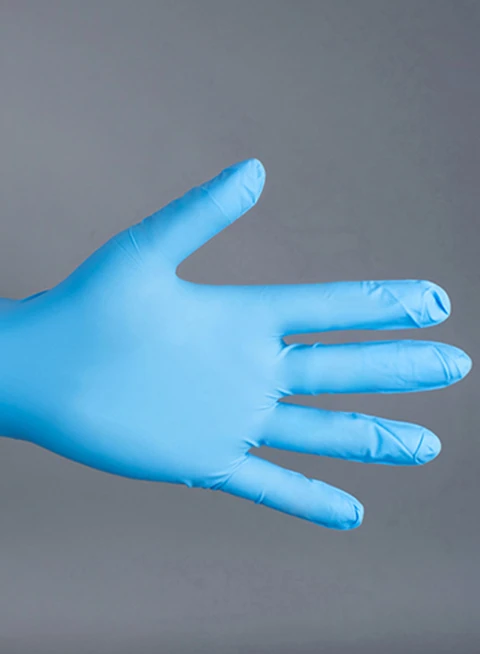
Cleanroom Nitrile Gloves
Nitrile gloves provide a strong physical barrier between the operator's hands and the product.
They are commonly used where contamination control and disposable protection are priorities.
However, long-term wear may create heat and sweat accumulation because nitrile is relatively impermeable.
Cleanroom Nitrile Gloves
For applications where operators wear gloves for many hours, comfort can become an important part of contamination control because excessive sweating and frequent glove adjustment can affect the operator's behavior.
For example, our seamless ESD cleanroom gloves integrate conductive fibers into the polyester fabric beneath the coating rather than relying only on a temporary surface treatment.
This approach is designed to provide stable ESD performance while maintaining the characteristics of a cleanroom glove.
* There are other types of cleanroom gloves made of different materials, but we won't go into detail here!
For example, our seamless ESD cleanroom gloves integrate conductive fibers into the polyester fabric beneath the coating rather than relying only on a temporary surface treatment.
Common choices include:
Cleanroom vacuum cleaners
Cleanroom-compatible mops
Cleanroom buckets
Disinfectants where required
Cleanroom wipes
Low-lint cleaning tools
Approved cleaning agents
Waste collection systems
The exact cleaning chemicals and tools should be compatible with the surfaces and processes in the facility.
ISO 14644-5:2025 explicitly includes cleaning programmes and special cleaning within the cleanroom operations control programme.
————
How Should Materials Enter an ISO Class 6 Cleanroom?
Material transfer is an important contamination-control step.
A typical process may involve:
External area → Packaging removal → Cleaning → Material transfer → Controlled area
The exact procedure depends on the facility.
Packaging that is heavily contaminated should not simply be brought directly into the cleanroom.
This is why cleanroom-compatible packaging, transfer procedures, and material handling rules are important.
ISO Class 6 is commonly associated with Class 1,000 under the older FED-STD-209E terminology. Today, ISO 14644-1 is the applicable international classification system for airborne particle cleanliness.
The choice depends on the process. Cleanroom nitrile gloves are commonly used for contamination barriers, while properly processed seamless gloves can provide a combination of cleanliness, flexibility, breathability, and ESD performance.
No. ISO Class 6 defines an airborne cleanliness classification; it does not prescribe one universal garment or consumable for every facility. Gowning, cleaning, consumables, and operating procedures should be selected according to the process and contamination-control requirements. ISO 14644-5:2025 addresses operational controls, while ISO 14644-18:2023 provides guidance on consumable suitability.
Conclusion
An ISO Class 6 cleanroom is not simply a room with fewer particles.
It is a system.
The air, equipment, garments, gloves, consumables, cleaning procedures, personnel, and material-transfer processes all work together.
For an electronics manufacturer, for example, choosing an ESD glove that generates too many particles can create one problem while solving another.
The best cleanroom strategy therefore considers the entire production environment rather than looking at a single specification.
Clean air is only the beginning. Clean operations are what make a cleanroom work.
If you are looking for high-quality gloves designed specifically for semiconductor and electronics manufacturing environments, you can explore our cleanroom seamless gloves designed for ISO Class 5 and Class 6 cleanrooms.