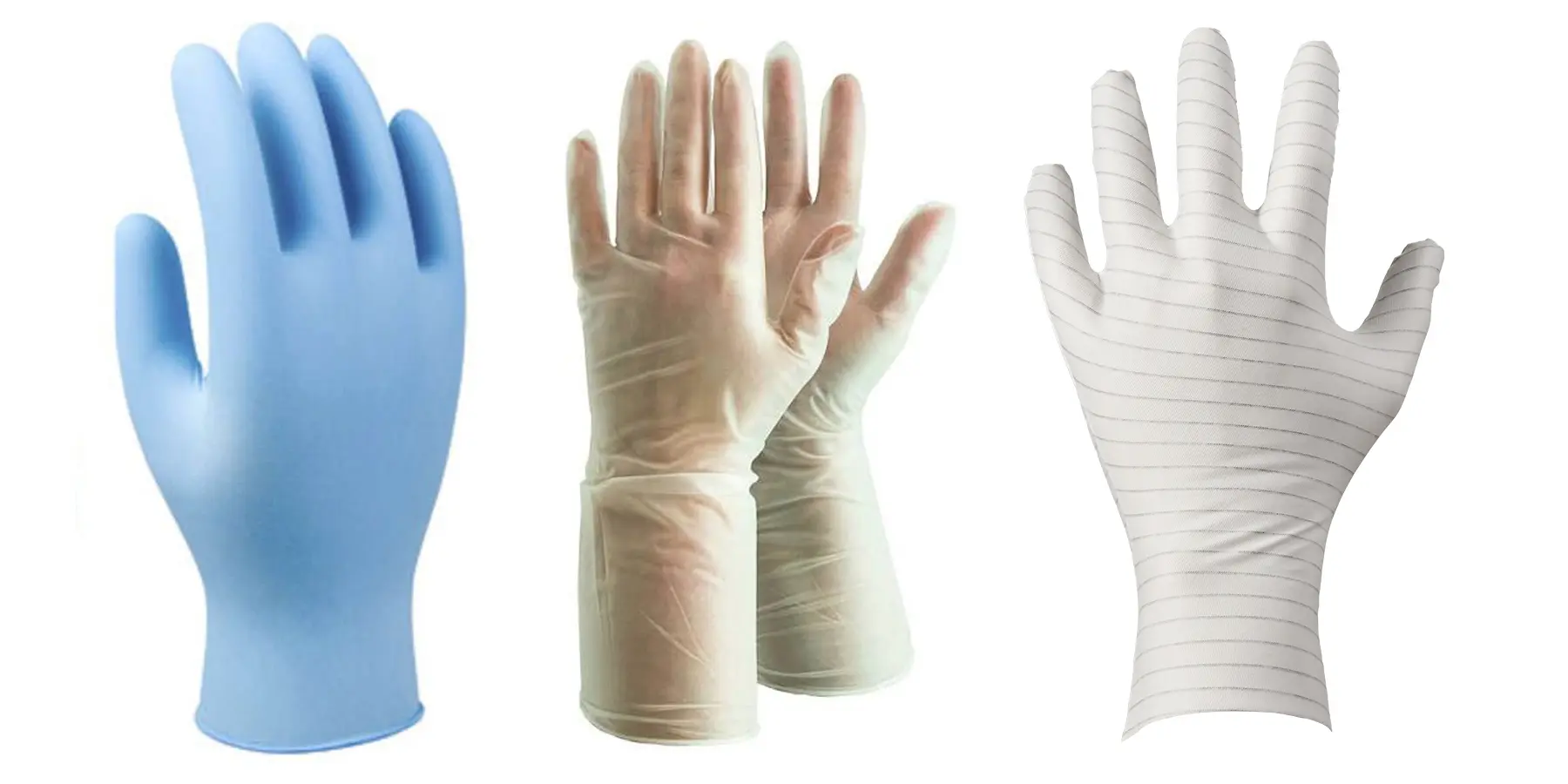
Nitrile gloves are widely used in electronics and clean manufacturing because they provide an effective physical barrier between the operator's hands and the product.
ESD nitrile gloves may use conductive or antistatic additives in the nitrile material to help dissipate electrostatic charge.
Advantages:
Good contamination barrier
Good chemical resistance
Easy to replace
Low initial particle shedding
Good protection against fingerprints and skin contamination
Limitations:
Nitrile is essentially a relatively impermeable material.
For short operations, this may not be a major concern.
However, when operators wear nitrile gloves for many hours, heat and sweat can accumulate inside the glove.
For long shifts, this can affect comfort and the operator's overall experience.
ESD performance may also depend on the formulation and surface characteristics of the glove, meaning performance should be verified rather than assumed.
Vinyl gloves are generally made from PVC and are often selected because of their relatively low cost.
ESD or antistatic versions may incorporate additives designed to reduce surface resistance and dissipate static charges.
Advantages:
Low cost
Easy to put on
Suitable for short-term tasks
Reasonable contamination protection
Limitations:
Vinyl gloves generally offer less elasticity and tactile sensitivity than nitrile gloves.
They are therefore less suitable for highly precise repetitive operations.
Their ESD characteristics can also depend heavily on the formulation and surface treatment.
For demanding cleanroom applications, manufacturers should evaluate actual particle and electrostatic performance rather than choosing solely based on price.
Seamless gloves take a completely different approach.
Instead of making the entire glove from a polymer film, the glove is knitted from textile fibers.
For ESD applications, conductive fibers can be integrated into the textile structure.
In advanced seamless ESD cleanroom gloves, conductive fibers can be incorporated horizontally into the polyester fabric beneath the coating layer.
This creates conductive pathways within the glove structure.
As a result, the ESD function does not rely solely on a temporary surface treatment.
Advantages:
Excellent flexibility
Better breathability than impermeable gloves
Conductive fibers can provide stable ESD performance
High operator comfort
Suitable for long working periods
Can be designed for high-cleanliness environments
Limitations:
Higher manufacturing cost
More complex production
Requires specialized cleaning and processing for cleanroom applications
For manufacturers that require both ESD protection and long-term wearing comfort, seamless gloves can provide an interesting alternative to disposable polymer gloves.
There is no single glove that is perfect for every application.
Choose nitrile when:
You need a strong disposable barrier, chemical resistance, and simple contamination control.
Choose vinyl when:
Low cost and short-duration handling are the primary considerations.
Choose seamless when:
Operators need to wear gloves for long periods and both ESD protection and comfort are important.
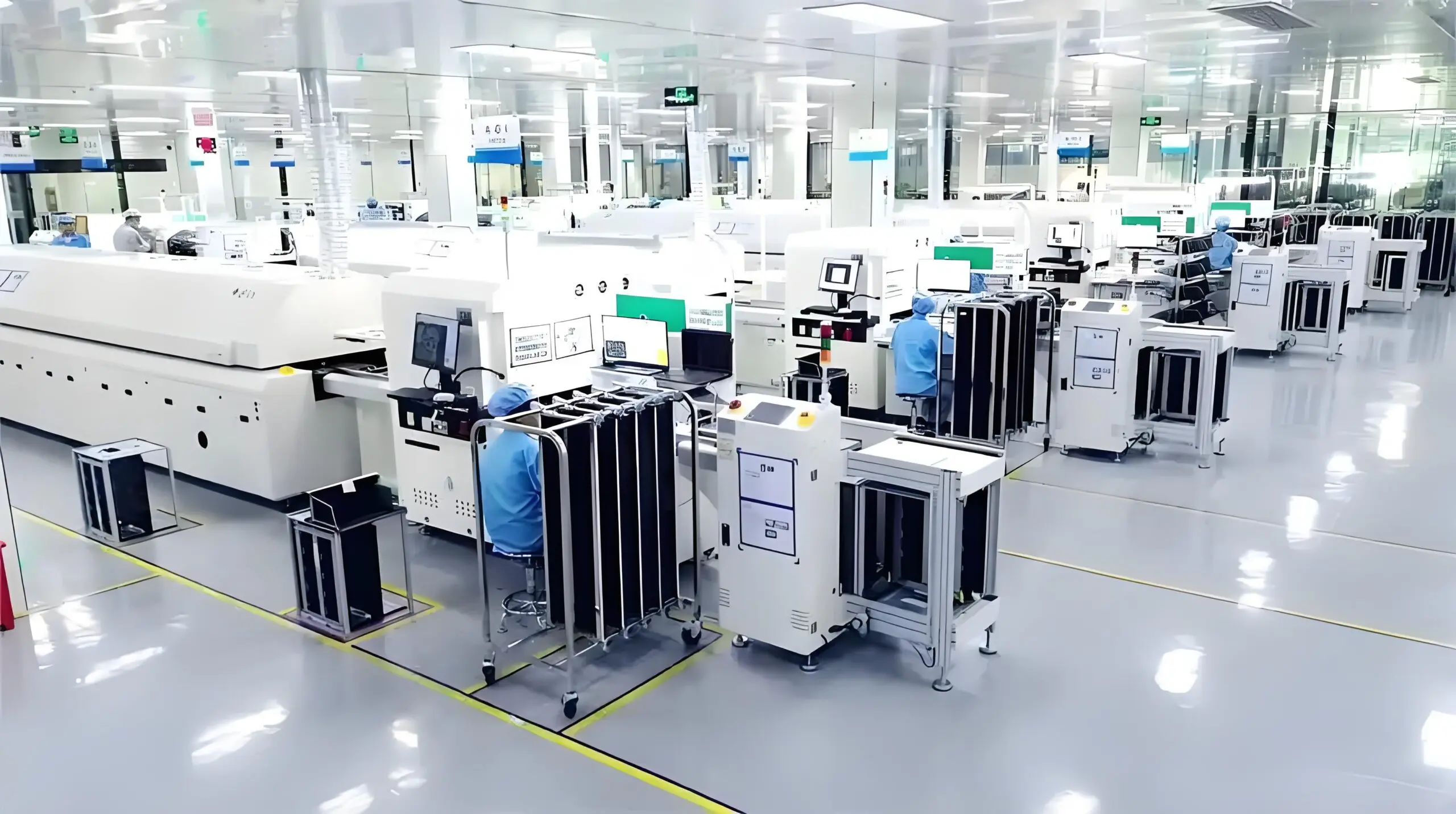
This is especially relevant for SMT assembly, inspection, electronics manufacturing, and other repetitive precision operations.
ESD Protection Is Only One Part of the Equation
One important lesson is that ESD protection alone does not make a glove a cleanroom glove.
A suitable glove may need to control:
Static + Particles + Human Contamination + Operator Comfort
A glove that performs well in one category may perform poorly in another.
For this reason, professional manufacturers should evaluate gloves according to the actual production environment rather than relying only on the words "ESD" or "antistatic" printed on the packaging.
FAQ
Yes, some nitrile ESD gloves are suitable for cleanroom applications, but suitability depends on the specific product's particle generation, ESD performance, and cleanroom processing.
Their main advantage is the combination of flexibility, breathability, long-term comfort, and integrated conductive fibers for stable ESD performance.
For long SMT shifts, seamless ESD gloves can be a strong option when operator comfort, flexibility, breathability, cleanliness, and stable ESD performance are all important.
Conclusion
Nitrile, vinyl, and seamless gloves each have their own place in electronics manufacturing.
Nitrile provides a strong disposable barrier.
Vinyl offers a low-cost option for simpler tasks.
Seamless gloves take a different approach by combining textile flexibility, breathability, and integrated conductive fibers.
For long-duration precision work in ESD-controlled cleanroom environments, this combination can provide a more balanced solution between product protection and operator comfort.
If you are looking for high-quality gloves designed specifically for semiconductor and electronics manufacturing environments, you can explore our cleanroom seamless gloves designed for ISO Class 5 and Class 6 cleanrooms.