Why Some ESD Gloves Can Enter a Cleanroom — and Some Cannot
Hello, this is the sales manager from Gaolebo Cleanroom Gloves. Many engineers and purchasing teams assume that any glove with ESD protection can be used inside a cleanroom. In reality, static control and contamination control are two different requirements. A glove may provide excellent electrostatic discharge (ESD) performance while still generating unacceptable levels of particles. Understanding how different ESD gloves work helps manufacturers choose products that meet both electrostatic and cleanroom requirements.
Static Control and Cleanroom Compatibility Are Different Requirements
A glove suitable for a cleanroom must address both:
Electrostatic discharge control
Particle contamination control
Some ESD gloves are designed primarily for static dissipation and may not meet cleanroom cleanliness requirements.
Knitted ESD Gloves
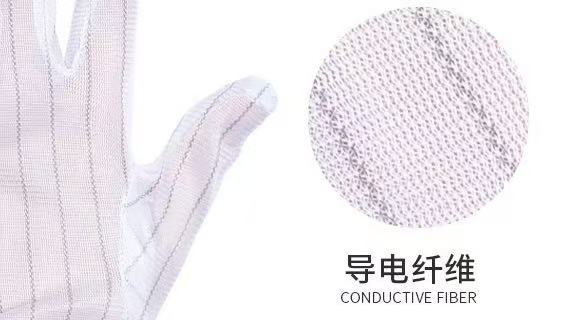
Traditional knitted ESD gloves achieve static dissipation by weaving conductive carbon fibers into polyester yarns.
The conductive fibers create pathways that allow static charges to dissipate gradually.
Advantages:
Low cost
Good flexibility
Effective ESD protection
Widely available
Limitations:
Fabric surfaces may generate particles
Difficult to achieve strict cleanroom classifications
Not designed for high-cleanliness environments
These gloves are commonly used in electronics assembly but are often unsuitable for cleanroom applications requiring ISO Class 7 or better.
PU-Coated ESD Gloves
PU-coated ESD gloves combine conductive knitted liners with polyurethane coatings on the fingertips or palms.
The PU coating improves grip and reduces direct fabric shedding.
Advantages:
Better grip
Popular in SMT production lines
Improved abrasion resistance
Limitations:
Coating wears during use
Particle generation increases once coating is damaged
ESD performance may gradually decline
The conductive function often depends on the integrity of the coating and exposed conductive pathways.
Antistatic Nitrile Gloves
ESD nitrile gloves typically achieve static control by adding conductive additives or antistatic compounds to the nitrile formulation.
Advantages:
Excellent contamination barrier
Low particle generation
Chemical resistance
Limitations:
Antistatic effectiveness may decrease with wear
Repeated friction may reduce performance
Surface treatments can degrade over time
Depending on formulation, conductivity may not remain stable throughout the product's service life.
Antistatic Surface Treatments and Antistatic Liquids
Some gloves achieve antistatic performance through surface-applied antistatic agents.
These treatments create a conductive layer that helps dissipate static charges.
Advantages:
Low manufacturing cost
Immediate ESD improvement
Easy implementation
Limitations:
Performance decreases after washing
ESD properties are temporary
Friction removes treatment layers
This is one of the most common reasons why some antistatic gloves fail to maintain performance during long-term use.
Cleanroom Seamless Gloves with Conductive Fibers
Modern cleanroom seamless gloves can achieve permanent ESD performance by integrating conductive fibers directly into the polyester substrate beneath the coating layer.
Instead of relying solely on surface treatments, conductive fibers are knitted horizontally throughout the glove structure.
As long as the glove surface remains intact, the conductive network remains functional.
Advantages:
Stable long-term ESD performance
Excellent wearing comfort
Suitable for cleanroom applications
Conductive function does not depend on temporary coatings
Reduced sweat buildup
Can achieve cleanliness levels comparable to Class 100 environments when properly processed and laundered
Limitations:
Higher washing cost
More complex production process
For manufacturers requiring both contamination control and stable electrostatic protection, this design offers a practical solution.
No. Some ESD gloves provide static protection but generate too many particles for cleanroom environments. Cleanroom compatibility requires both ESD control and contamination control.
Many gloves rely on surface coatings or antistatic treatments. Washing, friction, and wear can gradually reduce their effectiveness.
Seamless cleanroom ESD gloves can incorporate conductive fibers directly into the glove structure, providing more stable long-term static dissipation while maintaining low particle generation and high cleanliness.
Conclusion
Not all ESD gloves are suitable for cleanrooms. The key difference lies in whether the glove can simultaneously control electrostatic discharge and particle contamination. Understanding how different technologies achieve ESD performance helps manufacturers select gloves that meet both cleanliness and reliability requirements.
If you are looking for high-quality gloves designed specifically for semiconductor and electronics manufacturing environments, you can explore our cleanroom seamless gloves designed for ISO Class 5 and Class 6 cleanrooms.