How to Read APC Test Reports in Cleanroom Environments
Hello, this is the sales manager from Gaolebo Cleanroom Gloves. Many customers ask us how to interpret APC (Airborne Particle Count) test reports when evaluating cleanroom gloves and consumables. In this guide, we will walk you through how to read these reports step by step, so you can confidently assess cleanroom performance.
An APC (Airborne Particle Count) test measures the number of airborne particles within a cleanroom environment. It is one of the most important methods for verifying whether a cleanroom or its consumables meet required cleanliness standards.
In cleanroom operations, APC testing is used for:
Cleanroom certification
Monitoring environmental stability
Evaluating consumables such as gloves, wipes, and garments
Key Elements of an APC Test Report
To read an APC report correctly, you need to understand its key components.
Particle Size (μm)
APC reports measure particles at different sizes, commonly:
0.3 μm
0.5 μm
1.0 μm
3.0 μm
5.0 μm
Particle Count (counts/ft³ or counts/m³)
This shows how many particles are detected in a given air volume.
counts/ft³ → commonly used in US/China
counts/m³ → ISO standard
Lower values indicate better cleanliness.
ISO Cleanroom Class
Cleanroom classification is based on particle concentration limits.
ISO Class 5 ≈ Class 100
ISO Class 6 ≈ Class 1000
Each class defines the maximum allowable particle counts at specific sizes.
Background vs Test Results
Most reports include:
Background value → baseline environment
Test result → after introducing the sample (e.g., gloves)
Comparing these helps determine whether the product introduces contamination.
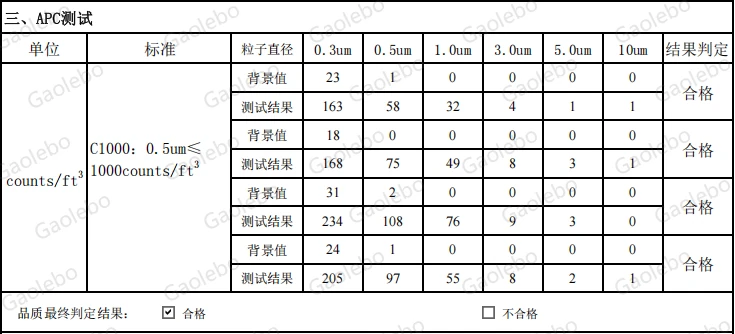
This is an excerpt from the APC test report for Gaolebo cleanroom seamless gloves, which we are making public. You may also analyze these gloves using the evaluation method recommended above for your reference.
Across multiple batches, all tested gloves met the Class 1000 cleanliness requirement. The particle count at 0.5 μm remained well below the maximum limit of 1000 counts/ft³ in all cases.
Although designed for Class 1000 environments, the test results indicate that the gloves perform close to Class 100 (ISO Class 5) levels in several particle size ranges.
In most cleanroom standards, the 0.5 μm particle size is the most critical reference point. It is commonly used to determine ISO classification levels and evaluate whether a cleanroom or consumable meets required cleanliness standards.
You need to compare the particle count values with the limits defined by the target cleanroom class (e.g., ISO Class 5 or Class 1000). If the measured values are below the maximum allowable limits, the test is considered compliant.
Background values represent the baseline particle level of the environment before testing. Comparing them with test results helps determine whether the product being tested introduces additional contamination.
Conclusion
Understanding how to read APC test reports is essential for anyone working in cleanroom environments. By focusing on particle size, counts, ISO class, and consistency, you can make informed decisions and ensure reliable contamination control.
If you are looking for high-quality gloves designed specifically for semiconductor and electronics manufacturing environments, you can explore our cleanroom seamless gloves designed for ISO Class 5 and Class 6 cleanrooms.